
Bulgaria is a net exporter again: how solar, batteries and Kozloduy support the region
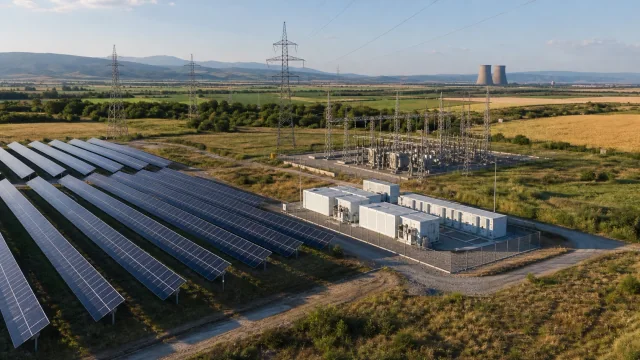
Strong electricity demand from Romania and Hungary has put Bulgaria at the centre of the regional market. The important development is not a sensational export figure, but the system’s growing ability to combine baseload generation, solar, batteries and interconnectors.
At a glance
Bulgaria is supporting power systems across the region at a time of stronger demand and operational difficulties linked to the record-low level of the Danube.
Energy Minister Iva Petrova confirmed on 4 August that Bulgaria was exporting electricity to the regional market. She said Kozloduy Nuclear Power Plant remained important not only to the Bulgarian system but also to security of supply in Romania. The ministry reported that the plant was following its production schedule and that there was no immediate risk to the security of Bulgaria’s power system.
Electricity System Operator chief executive Kiril Georgiev told Bulgarian National Television that reported demand from Romania was around 3,500–3,600 MW, while demand from Hungary was in the range of 4,000–5,000 MW. He described Bulgaria as a net exporter rather than a net importer in the current situation.
The figures quickly became headline material, but they require careful interpretation.
Market requests are not the same as Bulgarian exports
The Romanian and Hungarian figures cannot simply be added together and presented as 8,000–9,000 MW of electricity exported by Bulgaria.
Demand in a national market indicates a need for electricity or imports; it does not mean that the full volume will be supplied by a single country.
Hungary does not share a border or a direct interconnector with Bulgaria. Trading takes place through the coupled European market, where offers, demand and available cross-border capacity are matched through a common algorithm. The Bulgaria–Romania border has been part of Single Day-Ahead Coupling since 2021.
Physical flows across power lines are not necessarily identical to commercial exchanges. ESO explicitly notes that the energy shown in its cross-border physical-flow data does not automatically represent commercial exchange between the two countries concerned.
The accurate conclusion is therefore that Romania and Hungary have substantial regional electricity needs, while Bulgaria contributes according to its own generation, market prices and available cross-border capacity.
Bulgaria imports during cheaper hours and exports when prices rise
According to information presented by BNT, Bulgaria imports lower-priced electricity from Greece in some daytime periods. In the evening, as solar output falls and regional consumption and prices rise, the country exports electricity towards Romania.
This is not a contradiction. In an interconnected market, the direction of trade can change within the same day. Importing is economically rational when prices are lower than the cost of activating more expensive domestic generation; a few hours later the same system may have a competitive resource available for export.
That is the purpose of regional market coupling: electricity is directed to the countries and hours where it has the greatest value, within the technical constraints of the grid.
Solar generation is taking on a different role
Since the beginning of 2026, electricity generation in Bulgaria has risen by close to 7%, with consumption recording a similar increase. The import-export balance remains positive while renewable generation is growing.
During the specific operational situation at the beginning of August, photovoltaic plants were the largest source of electricity in some daytime hours, followed by Kozloduy, thermal and hydropower plants. The ESO snapshot cited by BNT put solar generation close to half of total output at the observed moment.
This was a momentary system snapshot, not an annual average, but it illustrates how substantially Bulgaria’s generation profile has changed.
High midday photovoltaic output previously translated mainly into lower prices and a risk of curtailment. With large battery systems entering operation, part of that energy can now be stored and used or sold later in the day.
Batteries turn daytime surplus into an evening resource
BNT reported, citing ESO’s operational balance, that a significant share of solar electricity at the observed moment was being directed into battery systems for use when prices became more favourable later in the day.
This is one of the first visible examples of new battery capacity changing the actual operation of Bulgaria’s electricity market.
BESS value is not limited to buying low and selling high. Batteries can reduce sharp changes in net load, absorb solar production during low-price hours, discharge during the evening peak, provide balancing energy and system services, and make better use of existing grid capacity.
Storage does not remove the need for baseload plants or grid investment. It gives the system operator and market participants an additional tool for managing increasingly variable generation.
Kozloduy remains critical to the region
Despite the growing role of solar and batteries, the current situation also demonstrates the continuing importance of Kozloduy Nuclear Power Plant.
The record-low Danube level is creating difficulties for regional energy infrastructure. Bulgaria’s Energy Ministry said the plant remained on schedule and that measures had been taken to ensure safe operation if river levels continued to decline. ESO said the system was prepared to react even if nuclear output had to be restricted.
Kozloduy provides a predictable baseload resource, while solar and batteries add flexibility throughout the day. It is the combination of technologies that allows Bulgaria to meet domestic demand and participate actively in the regional market.
Bulgaria is not an ‘energy superpower’, but it has a strategic advantage
The current exports should not be treated as proof that every structural problem in Bulgarian energy has been resolved. The country still needs major investment in transmission and distribution networks, more transparent connection procedures, additional flexibility and a long-term replacement strategy for ageing capacity.
The events at the start of August nevertheless reveal a genuine competitive advantage. Bulgaria combines nuclear baseload capacity, rapidly growing solar generation, a substantial new battery portfolio and interconnections with several neighbouring markets.
ESO manages the national transmission system, transit flows across the country and parallel operation with Continental Europe. This gives Bulgaria a strong position from which to become a more important source of regional flexibility.
The real story is not a sensational export volume at one particular moment. It is that the system is beginning to use its resources more dynamically: importing during cheaper periods, storing part of daytime output and exporting when neighbouring markets need electricity most.
That capability will define the value of power systems in the next stage of the energy transition.