
Europe’s solar map is expanding north
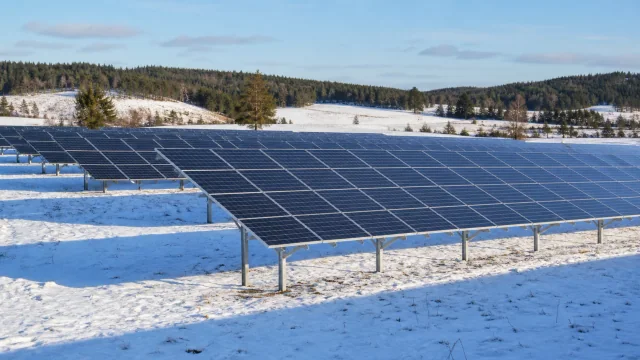
Solar power is no longer confined to Europe’s sunniest southern markets. Data from Finland, Sweden, Norway and Scotland show that PV can create value at higher latitudes — but project success increasingly depends on the business model, self-consumption, grid access and climate-adapted engineering.
At a glance
For years, the geography of European solar investment appeared relatively predictable. The largest projects naturally gravitated towards markets with more sunshine, higher annual yields and suitable land for utility-scale plants.
That picture is gradually changing.
By the end of 2025, installed solar capacity across the European Union had reached 359 GW after approximately 56.1 GW was added during the year. The European Commission continues to target at least 700 GW by 2030, meaning the next phase of growth cannot remain confined to the traditional southern markets.
More photovoltaic systems are being deployed in countries that rarely featured among Europe’s leading solar markets. Geography still matters: lower irradiation affects annual output, while strong seasonality remains a substantial challenge. What has changed is that competitiveness is no longer determined solely by the number of megawatt-hours produced.
Finland moves beyond 1.5 GW of solar capacity
Finland provides one of the clearest examples of solar’s expansion north. Preliminary data from the country’s energy regulator indicate approximately 1.6 GW of installed PV at the end of 2025. Around 1.25 GW consisted of smaller generation connected to distribution networks, while industrial-scale plants accounted for roughly 326 MW.
The growth of plants above 1 MW is particularly significant. It shows a market moving beyond small rooftop systems and beginning to attract capital for projects at industrial scale.
Smaller systems nevertheless remain the largest part of the market. Falling module prices and the high electricity prices experienced during the energy crisis encouraged households and smaller businesses to invest in on-site generation, although growth moderated during 2025.
Sweden demonstrates both the potential and the limits of northern solar
Sweden now has approximately 5.54 GW of grid-connected solar capacity spread across about 314,600 installations. A further 21,600 systems were installed during 2025.
The figures make Sweden a substantial European market despite weaker solar resources than those available in southern and south-eastern Europe. Development has not followed a straight line, however. Installed capacity increased by 15% during 2025, while the number of systems had grown by almost 70% between 2022 and 2023.
The Swedish Energy Agency points to the economic environment and changes to financial support for smaller producers as factors behind the slowdown. Solar is expected to keep growing, but larger installations are likely to account for a greater share of future additions.
Norway shifts towards larger commercial rooftops
At the beginning of 2025, Norway had approximately 767 MW of installed solar capacity. This remains a small segment of an electricity system dominated by hydropower, but the structure of the market is beginning to change.
According to the Norwegian Water Resources and Energy Directorate, 77% of PV systems are installed on residential roofs, yet they represent only 34% of installed capacity. Systems above 100 kW, including installations on large flat roofs, have recorded the strongest relative growth in recent years.
At commercial and industrial sites, solar electricity can be consumed directly. Project economics therefore depend not only on wholesale market revenues but also on the value of avoided grid consumption.
Norwegian data also show a decline in new residential installations during 2024 as expectations for profitability weakened. Northern growth should therefore be viewed as a transition towards more selective, economically justified investment rather than an unconditional solar boom.
Solar grows even in wind-dominated Scotland
Scotland remains a market led by wind power and storage, but solar capacity is also rising. Between the first quarter of 2025 and the same period in 2026, solar capacity increased by around 0.1 GW. Total operational renewable capacity reached 18.1 GW by the end of March 2026.
Solar still occupies a smaller position within Scotland’s extensive wind and battery portfolio. Its growth nevertheless confirms that PV can play an economic role in systems traditionally built around other renewable resources.
Why lower irradiation is no longer an automatic barrier
Solar resource remains a fundamental project variable. A plant in Bulgaria, Spain or Greece will normally produce more electricity each year than an equivalent system in Finland or Norway.
The economic value of that electricity also depends on the site’s demand profile, direct self-consumption, wholesale prices during production hours, grid connection cost and timing, tax and support mechanisms, cost of capital, storage options and the value of avoided network capacity.
This is why commercial rooftops, industrial plants, logistics centres and remote consumers can support viable solar projects even with lower annual yields. When a significant share of output is used on site, a project is not competing solely with the wholesale electricity price; it can also reduce supply costs, network charges and peak demand.
Cold climates offer advantages but require different engineering
Lower temperatures can improve module efficiency and may slow some degradation processes. They do not automatically offset lower irradiation or the strong seasonality of generation.
High-latitude systems must account for low solar elevation, snow accumulation, structural loading, frost effects on foundations and large differences between summer and winter production profiles.
IEA PVPS notes that bifacial modules and vertical PV arrays can offer advantages in these conditions. They make better use of direct, diffuse and snow-reflected light while potentially improving natural snow shedding.
This does not make northern projects technically simpler. They demand more precise assessment of the site, structure, shading, snow losses and actual hourly generation profile.
What this means for Bulgaria
Solar’s expansion into northern markets does not remove Bulgaria’s natural advantage. The country offers stronger solar resources and the potential for higher annual yield per unit of installed capacity.
That advantage alone is no longer enough to make a project competitive. As PV capacity grows, value will increasingly depend on when electricity is produced, grid availability, export constraints, negative prices and the owner’s ability to manage the asset actively.
Northern markets demonstrate that solar can create value even with a weaker natural resource when it is properly integrated with demand or a wider energy system.
For Bulgarian investors, the conclusion is clear: the future advantage may not belong to the project with the most sunshine, but to the one with the best combination of generation, grid access, consumption, storage and market strategy.
Europe’s solar map is indeed expanding north. This is not because solar resources have ceased to matter, but because PV is becoming a more mature market in which value is determined by the project’s entire economic model rather than location alone.